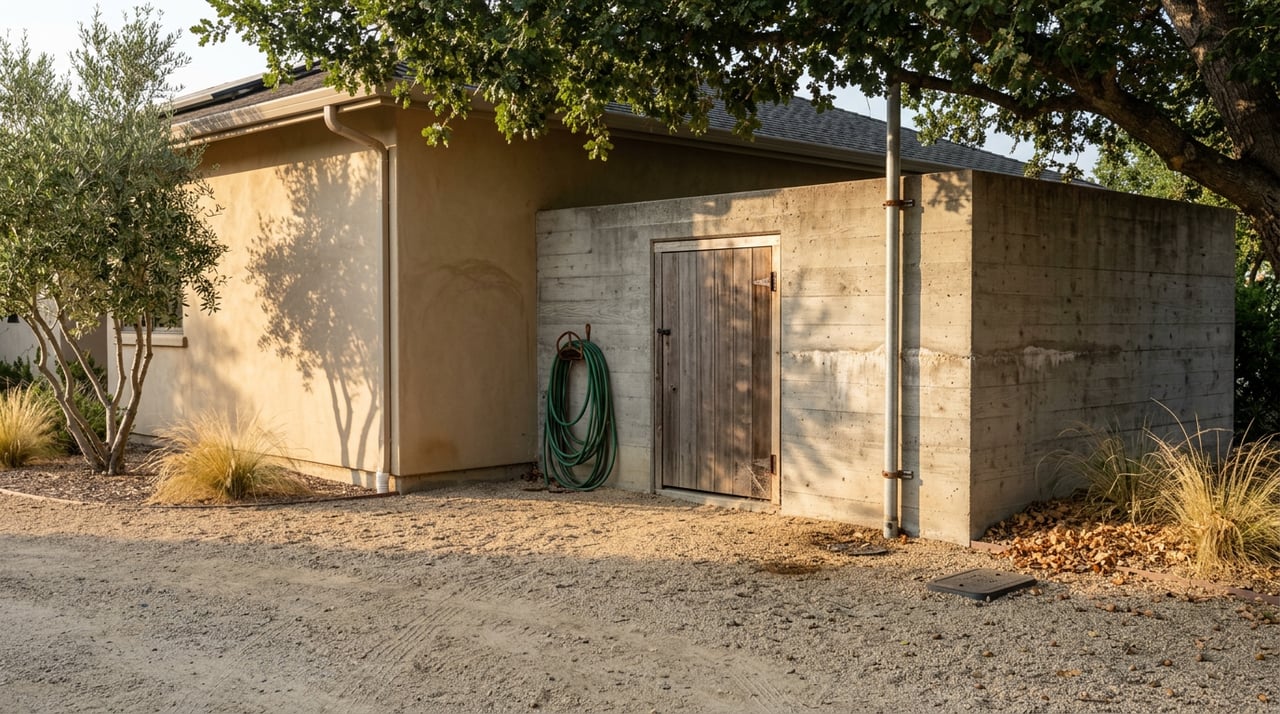
Say you've been watching a five-acre parcel outside Oakdale for a few weeks, the kind with a barn, cross-fencing, and a well that's kept the pasture green through two dry summers. Then a headline crosses your feed: Stanislaus County just approved a new groundwater management program. You read it as good news, or at least settled news, and you make your offer assuming the rules are decided.
They aren't decided for your parcel. The program the county approved on April 12, 2026 governs the Modesto Subbasin, and depending on exactly where that ranchette sits, Oakdale may not be in it.
That distinction is the kind of thing that shows up in due diligence, not in a listing description, and it's worth understanding before you write an offer on acreage in this area.
Two Subbasins, One County Line You Can't See From The Road
Stanislaus County sits over four separate groundwater subbasins, and they are not managed as one system. The Modesto Subbasin, the one that just got its new Groundwater Use Management Program, is bounded by the Stanislaus River on the north and the Tuolumne River on the south. It's a high-priority basin covering roughly 245,000 acres, and the program the county adopted in April layers in a pumping allocation framework and a well-mitigation strategy for wells that go dry, following a Groundwater Use Management Program the Stanislaus and Tuolumne Rivers Groundwater Basin Association finalized in January 2026.
Oakdale, on the other hand, is served by the Oakdale Irrigation District, and OID is a governing member not of the Modesto Subbasin but of the Eastern San Joaquin Subbasin, a much larger basin spanning 707,000 acres across San Joaquin, Stanislaus, and Calaveras counties. That subbasin has its own history, its own regulator, and its own numbers, and none of them are the ones in the April headline.
| Modesto Subbasin | Eastern San Joaquin Subbasin | |
|---|---|---|
| Governing agency covering Oakdale-area wells | STRGBA GSA | Eastern San Joaquin Groundwater Authority (OID is a member GSA) |
| DWR priority designation | High priority | Critical overdraft |
| Latest management action | County-approved allocation and well-mitigation program, April 2026 | GSP approved by DWR, July 2023 |
| Sustainability target year | 2042, according to the City of Modesto | 2040, according to the Eastern San Joaquin Groundwater Subbasin Groundwater Sustainability Plan (Revised) |
The Eastern San Joaquin Subbasin has been under closer state scrutiny for longer. It was estimated to operate at a deficit on the order of 90,000 acre-feet a year, and the Department of Water Resources classifies it as critically overdrafted, a designation the Modesto Subbasin does not currently carry. That's the piece a buyer relying on the news cycle would miss entirely: the property they're evaluating may sit inside the stricter, longer-running regulatory regime, not the one that just made local headlines.
If you're weighing a well replacement, a new irrigation well, or just want to know how much runway your existing well has before the next round of allocation rules tightens, the answer depends on knowing which subbasin actually governs your parcel, and that's a question worth putting to Oakdale Irrigation District or the county's Department of Environmental Resources before you're deep into escrow.
What This Means When You're Actually At The Table
None of this changes what a well physically does today. It changes what happens if that well needs work, replacement, or a new permit down the road, and it shapes how a seller's disclosures should read.
A few things worth confirming during due diligence on any acreage property in this area:
Who's licensed to touch the well. Any construction, alteration, deepening, or abandonment of a water well in Stanislaus County has to be done by a contractor holding a C-57 Water Well Contractor's license under the state Water Code. If a seller mentions recent well work, ask who did it and whether the paperwork matches.
Whether the water's actually been tested for nitrate. Stanislaus County's own well siting guidelines flag nitrate as a documented issue in the shallow aquifer across the county, tracing back to dairy farming and agricultural fertilizer use, with onsite septic systems noted as a secondary source. A standard potability test doesn't always isolate for it. On a property that's run livestock or sits near longtime dairy or row-crop land, a nitrate-specific test is worth the extra line item.
The setback between the septic system and the well. According to Lanik Septic, California requires a minimum separation between a septic tank and a well to protect drinking water, and the exact distance is set by the local health authority rather than a single statewide number. On older ranchette parcels where outbuildings, wells, and septic systems were sited decades apart from current code, it's worth having the county Environmental Resources office confirm the layout still complies rather than assuming it does.
Who pays for the septic inspection. In California transactions, responsibility for the septic inspection typically defaults to the seller, but it's a negotiable term, not a fixed rule. Make sure it's spelled out in the contract rather than assumed.
Whether the parcel is inside a Special Management Area. The county has designated specific zones where local soil or hydrogeologic conditions warrant extra scrutiny on new well permits. If you're planning to drill or replace a well rather than just use what's there, this is worth checking before you're attached to a closing date.
Local septic contractors who work Oakdale acreage regularly, Silver Valley Septic is one example, will tell you the same thing plumbers and well drillers have said for years out here: annual inspection and a pump-out on a three to five year cycle keeps a system out of trouble, but the inspection only tells you what's true today. It doesn't tell you what regulatory shift is coming for the aquifer underneath it, and that's the part that actually affects long-term value and insurability of the property.
Why This Matters More For Oakdale Than It Does For Modesto Proper
A buyer looking at a subdivision lot on municipal water in Modesto doesn't need to think about any of this. The city's own groundwater sustainability page is clear that Modesto's supply comes primarily from the Modesto Subbasin and is managed toward the same 2042 target the county just built new rules around. That buyer's exposure to subbasin politics is close to zero.
An Oakdale ranchette buyer's exposure is not zero. You're likely on a private well. Depending on exactly where the parcel sits, that well may be subject to a subbasin's stricter overdraft designation and earlier sustainability deadline; the authority governing it may also differ from the one that just got local press coverage. That's not a reason to avoid acreage in this area. It's a reason to ask the right questions before you're the one holding the well.
A Few Questions Worth Asking Directly
Does the county's new April 2026 program affect my well if I'm buying near Oakdale? Only if your parcel is actually inside the Modesto Subbasin. Properties served by Oakdale Irrigation District fall under the separate Eastern San Joaquin Subbasin, governed by a different GSA under an older, DWR-approved plan.
How do I find out which subbasin my parcel is in? Oakdale Irrigation District and the Stanislaus County Department of Environmental Resources can both confirm subbasin boundaries for a specific parcel. It's a phone call or an email, and it's worth making before you write an offer contingent on well condition.
Should I test for anything beyond standard potability? Ask specifically for a nitrate test given the documented regional pattern tied to agricultural land use. It's a small add-on to a standard well test and it answers a question a basic potability screen won't.
If you're comparing ranchette listings around Oakdale and want someone who'll walk the well, the septic, and the paperwork with you rather than just the square footage, that's the kind of groundwork Lisa Vandermeer does before you ever make an offer. Schedule a free consultation and let's talk through what's actually under the acreage you're considering.
This article is general information, not legal, tax or financial advice. Consult a qualified professional about your situation.